![]() |
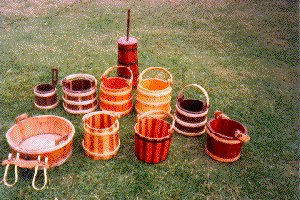
BucketsHere is some cooperage that I have made. They contain no glue or nails. They are held together by the hoops and the bottom. The woods used on these are Cherry, Walnut, White Pine, Loblolly Pine, Cedar and Red Oak. I have no access to Ash so I have never worked it. I'll probably never do another oak one. The wood is just to hard to work and I spend all my time sharpening the tools.The small ox yoke is Cherry with Maple bows. |
|---|
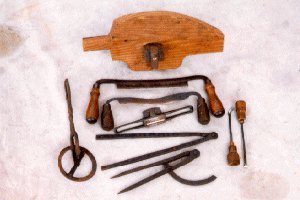
ToolsHere are some of the homemade cooper's tools that I use.
|
![]() |
|---|
![]() |
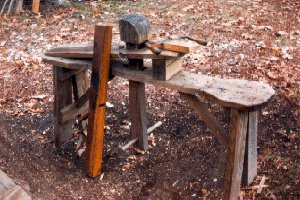
The Shaving HorseI made this shaving horse which is used to hold the wood pieces while the drawkives, chisels and spokeshave are used to shape them. It is just a big vise(clamp) used to hold the work. The upright piece is a long joiner I made from an oak block and and disk parts. It fits on top of the "horse" when the clamp is removed. The "work" is pushed down over the joiner. |
|---|
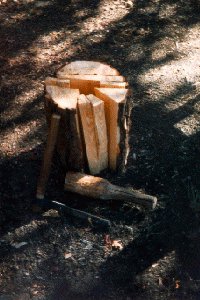
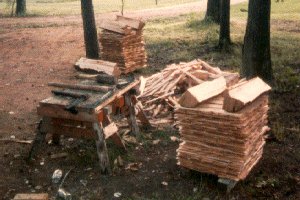
WoodThe staves, bottom board(s) (and wooden hoops if used) are rived from a straight grained piece of wood. Working twisted grain wood with drawknives, spokeshave and a long joiner is not much fun. For the staves, the wood is first halved and then quartered and then eighthed? The heart and edge of each eighth is then rived out as shown on the forward half of the block. The bottom boards can be obtained by riving completely across the block as shown on the back half of the block. Again, rive out the heart and edges. The froe and cudgel shown are used to rive the pieces. The same procedures can be used to make shingles but the starting block should be much larger - at least 14" in diameter - and the sections rived until about 1/4 to 3/8" thick. | ![]() |
|---|
StavesEach stave is shaped with draw knives, a spoke shave and finally a long joiner. A stave is tapered slightly such that for eight inches of length, the small end is approximately 7/8 the width of the larger end. The ruler divider is used in conjuction with the long joiner to insure the correct angle of the stave's edges. The staves are assembled using temporary metal hoops or bands. The croz (a kerf) is then cut using the croz saw in the bottom of the staves for inserting the bottom boards . |
BottomThe bottom board(s) are shaped with the drawknife, spokeshave and long joiner. If more than one board is required, the matching edges are smoothed with the long joiner. The required diameter of the bottom is measured and then laid off with the dividers. The bottom is then cut out and the edges smoothed with a wood rasp. The edges of the bottom are beveled to 1/4 inch all the way around to fit in the croz. |
![]() |
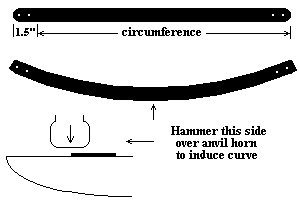
Metal HoopsThe metal hoops I make from used shipping/binding straps obtained free from lumber yards or construction job sites. I measure the circumference of the bucket and then lay it off on the hoop. I allow 11/2 inches for lapping and riveting. Peaning one side of the hoop on the anvil horn will produce a curved hoop which, when wrapped around the bucket, will fit the bucket's taper. Pean after measuring. |
|---|
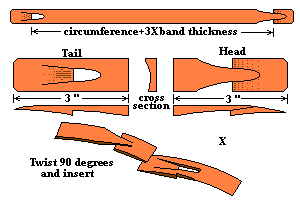
Wooden HoopsThe wooden hoops are white oak or hickory, rived out of a 6" sapling, and shaped on the shaving bench with the draw knives and burnishing tools. Tapering the hoop thickness, as shown in the cross section, will, when wrapped around the bucket, fit the bucket's taper. I make mine 1/4" top and 3/16" bottom. I also scarf the inside of the hoop with the curved draw knife. This, in effect, produces two hoops at one place on the bucket. These hoops are heated in boiling water prior to being installed. |
![]() |
|---|
![]() |
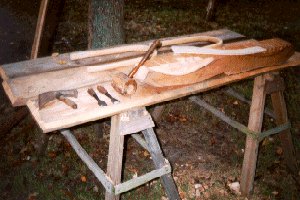
Starting the yoke. A pattern was used and is shown on the yoke. A chisel was used to rough cut the curved portions and a cooper's adz was used to smooth them out. These tools are shown in the picture. These bows were already made by someone else but I have made them from hickory, white oak and maple, steamed 'em and wrapped 'em around a tree to shape them. |
|---|
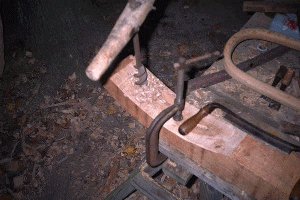
| Boring the ox bow holes using a hand auger. I have about 4 of these things. This one cuts a 13/4 inch diameter hole about 3/16inch at a time and required many rest stops. I got this auger from my cousin-in-law's uncle and it did an excellent job. Notice the draw knife, chisels and bow. | ![]() |
|---|
![]() |
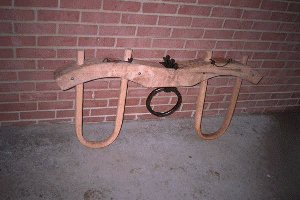
After a day in the forge to "iron it out" behold the finished product. "Git! Back! Gee! Haw! Whoa!"The only words a steer needs to learn??? |
|---|